
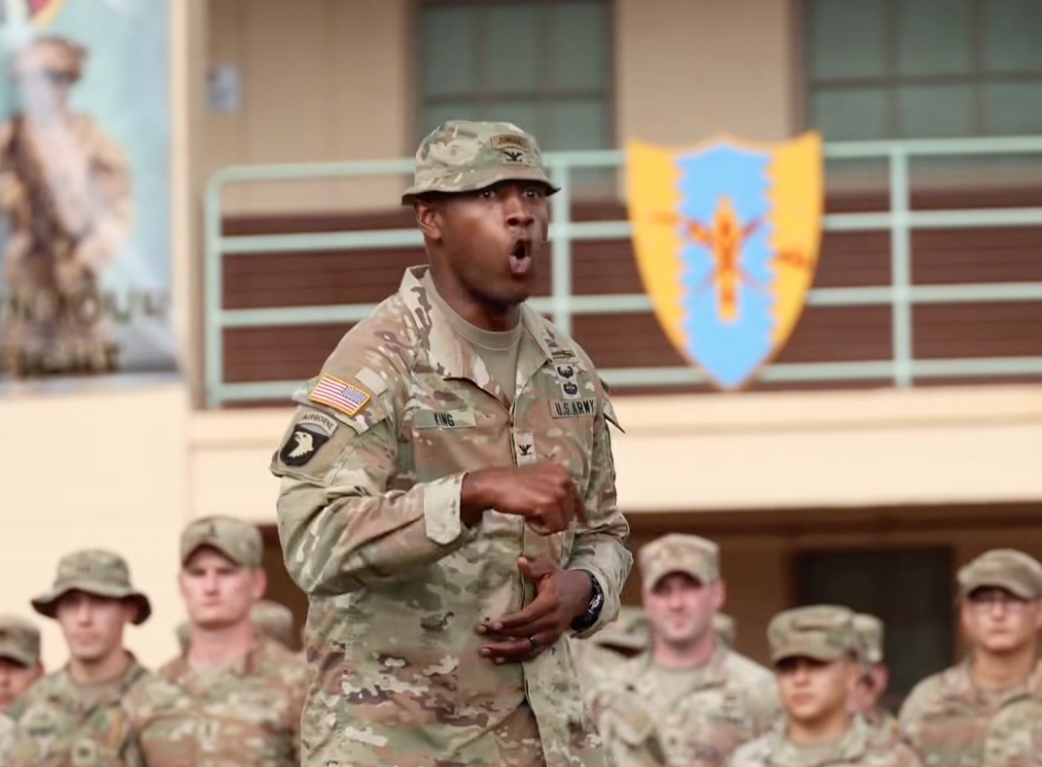
A video of an Army brigade commander delivering a short, high-energy address to his troops went viral after being shared publicly on Monday, resonating across social media with soldiers and veterans alike. The speech itself was simple and direct — a commander setting standards and building momentum ahead of Tropic Lightning Week 2025.
The response was immediate.
“This Bronco Bde CDR just fired this ol retired up,” one commenter wrote.
“He almost got me out of retirement with that speech,” another added.
Others joked about being ready to “run through a wall” or offered two claps and a Ric Flair — language familiar to anyone who has spent time in a motivated infantry formation.
What viewers did not hear in the video — but what gives the moment additional weight — is that the officer delivering it now commands one of the Army’s most significant force-design experiments.
Col. Adisa T. King is the commander of the 3rd Mobile Brigade (Prototype), 25th Infantry Division, a formation that operated for years as the 3rd Infantry Brigade Combat Team before being transformed under the Army’s Transformation in Contact initiative.
King brings more than two decades of service to the role.
A native of Jackson, Mississippi, he graduated from the United States Military Academy at West Point in December 2000, commissioning as an infantry officer. Over the next 24 years, his career crossed nearly every major type of ground combat formation the Army fields. He served in mechanized infantry with the 2nd Infantry Division in Korea, airborne infantry with the 82nd Airborne Division, air assault units in the 101st Airborne Division, and later commanded a cavalry squadron.
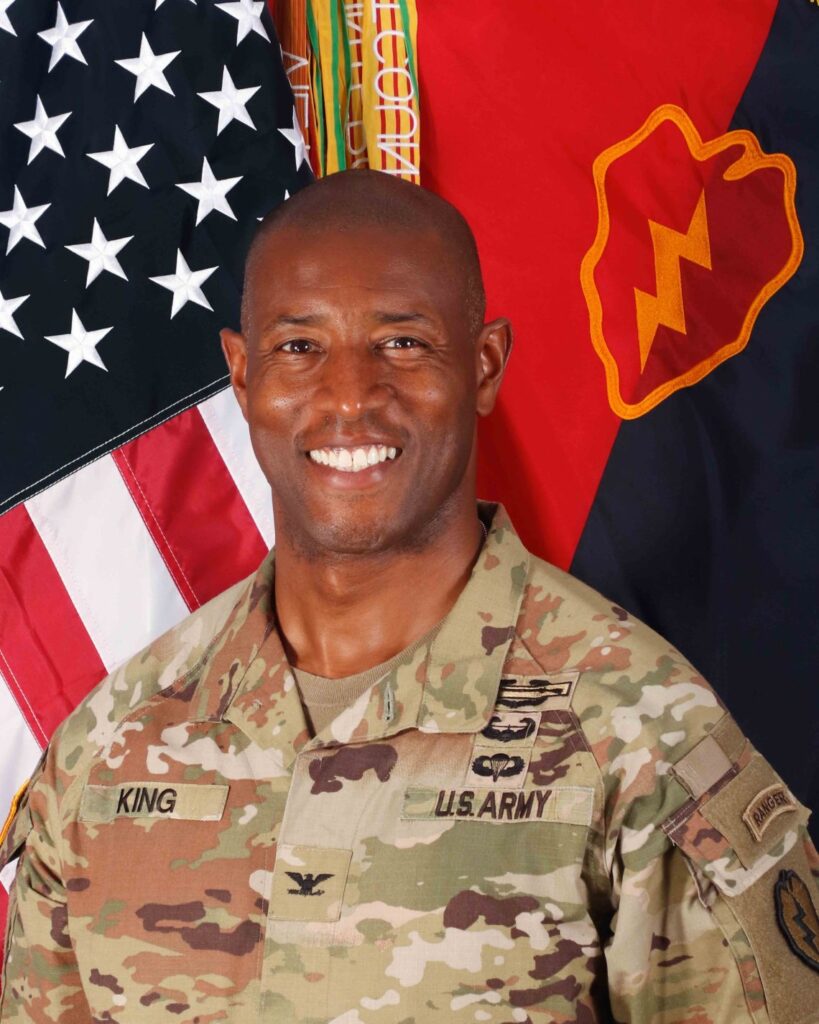
His operational experience spans combat deployments to Iraq and Afghanistan, including service in Samarra during Operation Iraqi Freedom and multiple deployments supporting Operation Enduring Freedom and Operation Resolute Support. Outside of combat, he supported domestic disaster response efforts during Hurricane Katrina, an experience that tested leadership under chaotic, resource-constrained conditions.
King’s background also includes time at the strategic level. He served as an aide to two Secretaries of the Army and worked within the Office of the Chief of Legislative Liaison, exposing him to how operational decisions intersect with policy, resourcing, and long-term force planning. He later attended the U.S. Army War College, further preparing him for senior leadership.
That mix of tactical credibility and institutional experience matters — especially for a brigade tasked not just with readiness, but with experimentation.
In late 2023, the Army selected the 3rd Brigade of the 25th Infantry Division to serve as a test bed for what it calls a Mobile Brigade. Throughout FY2024, the unit was redesignated and began operating under a new concept aimed at answering a difficult question: how to adapt a traditional infantry brigade for future warfare in the Indo-Pacific without breaking what already works.
Under the Mobile Brigade construct, the unit is expected to operate more dispersed, rely less on centralized command-and-control, move faster with lighter logistics, integrate unmanned systems at lower levels, and fight in environments where communications and GPS cannot be assumed. The brigade remains infantry at its core, but how it moves, sustains itself, and fights is being deliberately stressed and reshaped.
Leading that kind of unit requires more than charisma.
It requires credibility with soldiers who know when they are being sold a concept versus being led through change.
That may explain why the video struck such a nerve. The comments were not polished praise; they were the kind of reactions soldiers reserve for commanders who feel authentic. One former soldier noted King was the best squadron commander he ever had. Others emphasized how the speech captured the spirit of the Broncos — aggressive, disciplined, and confident.
For an Army attempting to redesign its formations while maintaining trust within the ranks, that reception matters.
The video does not explain what a Mobile Brigade is, nor does it need to. What it shows is the human side of transformation: a commander with enough experience to lead change, standing in front of soldiers being asked to operate differently than their predecessors.
Whether the Mobile Brigade becomes the Army’s future standard remains undecided. What is clear is that if the Army is going to experiment with how it fights its next war, it has placed that experiment in the hands of a commander who has spent more than two decades fighting, leading, advising, and learning across the full breadth of the profession.
And judging by the response, the soldiers — past and present — noticed.
© 2025 TheSaltySoldier.com. All rights reserved. Reproduction or redistribution of this article is strictly prohibited without written permission.
Damn, I’m retired a couple years and they come out with new headgear?